
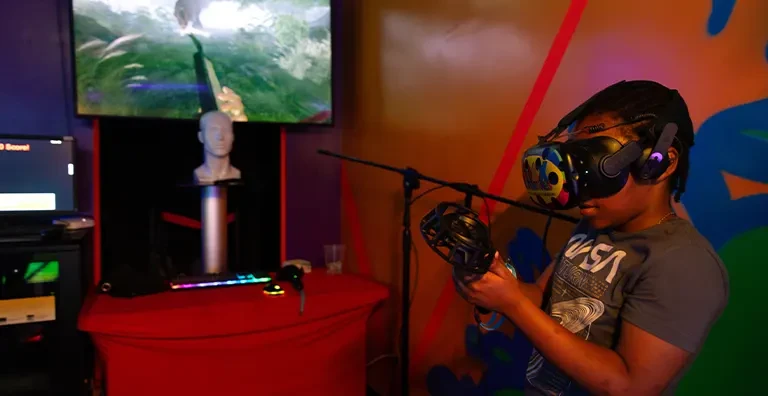
Why Are Video Games So Popular Among Kids in New York?
Kids love video games in NYC because they fit city life: fast, social, flexible, and great indoors. The sweet spot for parents is balance—mix arcade games, console gaming, and active play inside a supervised family gaming room so fun, movement, and structure all show up together.
New York kids grow up fast. They learn to swipe before they can tie laces. They ride the subway, they know what “after-school” actually means (homework, clubs, and, yes, video games in NYC). Screens are part of city life—so are friends, family, and the need to blow off steam indoors. Put that together and you get a simple truth: kids gaming isn’t just “entertainment.” It’s social time, learning time, and—when you pick the right environment—family time. That’s where a family gaming room with consoles, arcades, and space for grown-ups changes the whole experience.
Why are kids in NYC especially drawn to video games?
City living is a beautiful kind of busy. Space is tight. Schedules are packed. Weather swings from park-perfect to nope. Video games in NYC fit the rhythm: quick sessions between activities, co-op play with friends in other boroughs, competition without the commute. Schools lean into digital tools, so kids are already fluent with devices; games build on that fluency with challenge, creativity, and collaboration.
Another very New York thing: kids love to do things together—but not always in the same way. One child wants strategy. Another wants speed. A third wants to build. Games offer all three in one place—then swap roles next round. That flexibility makes gaming a natural go-to for city families trying to keep siblings (and cousins) happy at the same time.
Alex, Owner of Max Adventures: “We set up stations so every kid finds a win—fast. Short arcade bursts, chill co-op on the couch, and an active area to reset the energy. That mix keeps smiles high and meltdowns low.”
What’s the difference between arcade games and console gaming for kids?
Think of arcade games vs console gaming as two flavors of the same fun:
- ● Arcade games are kinetic and immediate. You walk up, you play, you laugh. Short rounds. Big reactions. Perfect for birthday energy and mixed-age groups because the on-ramp is almost zero.
- ● Console gaming stretches into deeper sessions. Kids sink into a world, learn controls, revisit goals, and play shoulder-to-shoulder. Local co-op on the couch, tournament rotations, “winner stays on.”
When a venue offers both, the room breathes. A group can run high-energy arcade challenges, then rotate to consoles for co-op stories or sports matches. Variety keeps the whole party engaged—and gives parents a chance to sit, watch, and actually enjoy the show.
Quick Comparison — Arcade vs Console vs Motion-Based
| Dimension | Arcade games | Console gaming | Motion-based / Active |
|---|---|---|---|
| Session length | 1–5 minutes | 10–40 minutes | 1–3 minutes |
| On-ramp for new players | Very easy | Moderate | Easy |
| Social feel | Crowd-friendly, quick turn-taking | Shoulder-to-shoulder co-op | Team energy, physical |
| Movement | Low–Medium | Low | High |
| Best for | Mixed ages, party hype | Deeper play, small groups | Resetting energy, breaks |
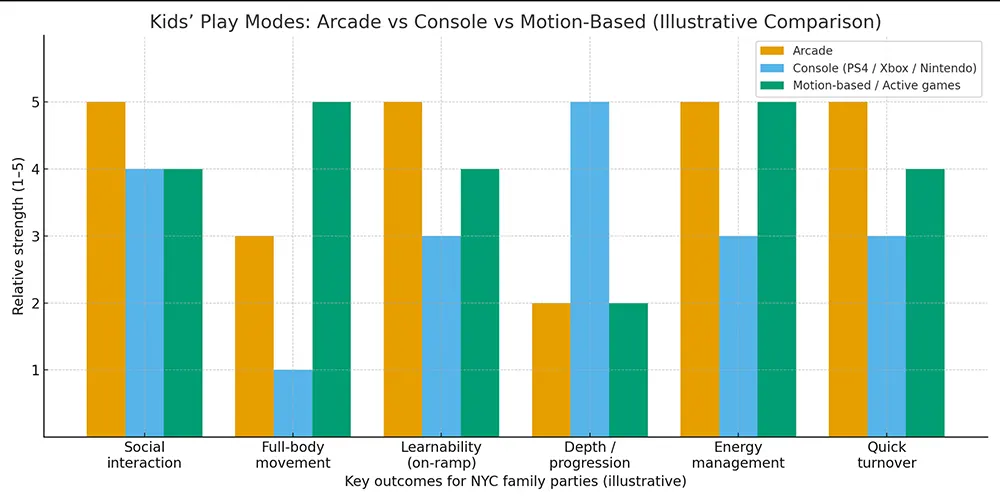
Visual: Use the chart “Kids’ Play Modes: Arcade vs Console vs Motion-Based*
*Alt text: “Bar chart comparing social, movement, learnability, depth, energy management, and quick turnover across three play modes.”
What consoles can kids enjoy at Max Adventures?
In Max Adventures’ family gaming room, kids plug into familiar platforms with kid-friendly hits and easy on-ramps:
- ● PS4 — sports titles, platformers, party games that support quick swap-ins.
- ● Xbox — racers, action adventures, team-based party picks.
- ● Nintendo — the home of Mario, couch co-op, and all-ages classics.
Result: kids choose their lane, share controllers, trade tips, and bring younger siblings into the game without feeling “too hard” or “too serious.” It’s birthday-party gaming that actually includes everybody.
What are the most popular video games for kids right now?
Trends shift; some favorites don’t. For video games for kids that work in NYC party groups, this mix covers co-op, competitive, creative, and dance-it-out:
- ● Minecraft — Creative, cooperative, endlessly rebuildable.
- ● Mario Kart 8 Deluxe — Pure couch-co-op joy; fast rematches.
- ● Super Mario Bros. Wonder — Classic platforming with wild transformations.
- ● Just Dance — Great icebreaker between pizza and cake.
- ● Rocket League — Soccer with rocket-boost cars.
- ● Animal Crossing: New Horizons — Calm, cozy, creative.
- ● NBA 2K / EA Sports FC — Quick tournament brackets.
- ● Overcooked! (series) — Team chaos that teaches communication.
Alex: “We rotate titles by season but keep the ‘instant fun’ staples. If a game makes kids share controllers and cheer each other—it stays.”
How do parents ensure healthy screen time with gaming?
A few guardrails turn screen time for kids into steady routine instead of a battle:
- ● Set session rules upfront. “Two races, then a snack.” Predictable beats punitive.
- ● Pair play with movement. Alternate consoles with arcades or active stations.
- ● Co-play sometimes. Ask about goals; celebrate wins.
- ● Curate content. Favor age-appropriate or educational video games on school nights.
- ● Prefer supervised spaces. A staffed, structured venue balances screens with real-world fun.
Bottom line: screen time can be healthy time when it’s bounded, social, and mixed with movement.
How does a gaming console room enhance family entertainment?
Parents want to be there—but not always in there. A well-designed family gaming room gives grown-ups comfy seating and clear sightlines while kids rotate through stations. Shared play creates shared language—“Pass me the red shell!”—followed by the same teammates cheering a sibling on an arcade round. Fewer bored kids in corners. More laughter you can actually enjoy from a seat that doesn’t wobble.
Why do interactive games like High Five and table soccer stand out?
Reflex duels and tactile games hit differently. High Five rewards quick reactions; kids love the head-to-head feel. Table soccer (foosball) runs on simple rules, tight rallies, and lightning comebacks. Both are short, replayable, and perfectly “one more time!” friendly—ideal bridges between longer console sessions. They’re also great equalizers: kids who aren’t into controllers jump in and compete right away.
What are active or motion-based games and why do they matter?
Kids need to move. Motion-based attractions (interactive floors, dodge-and-jump challenges, light-up targets) take the “game” concept off the screen and into full-body play. Reaction time, balance, coordination—it’s all there. For parties, these stations reset the room: after a focused console match, the group sprints, hops, and laughs its way back to center. Movement doesn’t replace gaming; it supports it.
Are video games good or bad for kids? What does the evidence say?
It’s both—and it depends. Games can sharpen attention to detail, build hand-eye coordination, improve spatial reasoning, and teach persistence. They can also swallow time if boundaries fade or content skews too old. The sweet spot sits in the middle: pick age-appropriate titles, limit total time, mix seated play with active stations, and make sure games don’t elbow out sleep, school, or real-world friendships. When those boxes are checked, families often report better moods, stronger sibling bonds, and fewer “there’s nothing to do” moments.
What are the best educational video games for kids?
A quick starter set that blends learning with fun (and still works in a party rotation):
- ● Minecraft (logic, planning, collaboration)
- ● LEGO games (reading prompts, problem-solving, humor)
- ● Lightbot / Human Resource Machine (intro-to-logic puzzles)
- ● Mario Maker 2 (design-test-iterate—engineering in a nutshell)
- ● Kerbal Space Program with adult guidance (physics, orbital mechanics)
If a title makes your child ask, “What happens if…?” you’re in a good place.
How does a gaming-plus-arcade setup help NYC parents manage screen time?
You get natural break points. Console match ends? Send the next group to arcades. Arcade round over? Back to Nintendo for cozy co-op. The room itself creates a rhythm of play–move–play. Staff-led activities help too: quick announcements, “final round” calls, organized rotations. Parents don’t need to micromanage; kids don’t feel dragged out of fun—they’re just moving to the next thing.
Why is Max Adventures’ mix ideal for modern families?
Because it respects attention spans and energy cycles. The space flows from one kind of engagement to another: console couches for story and strategy, arcade walls for reflex and laughter, active stations for full-body reset, and a parent lounge where grown-ups can actually relax. Everything is designed to be inclusive—toddlers to teens, siblings, cousins, classmates. Everyone gets a turn that feels like their kind of fun.
Alex: “Our job is to make parties effortless. We guide rotations, support shy players, and keep the vibe upbeat so every kid leaves feeling like they won.”
FAQs
What consoles are available for kids to play at Max Adventures?
PS4, Xbox, and Nintendo—set up for easy rotation and shared play with party-friendly hits and co-op titles.
What are the most popular video games for kids right now?
Crowd-pleasers: Minecraft, Mario Kart 8 Deluxe, Super Mario Bros. Wonder, Just Dance, Rocket League, Animal Crossing, NBA 2K / EA Sports FC, and Overcooked! for teamwork and laughs.
What’s the difference between arcade games and console gaming for kids?
Arcades deliver short, high-energy bursts (great for mixed ages). Consoles offer longer sessions, story, and teamwork—perfect for couch co-op.
How do parents ensure healthy screen time with gaming?
Set clear time blocks, mix play with movement, co-play when you can, use family settings, and prefer social, age-appropriate titles—especially on school nights.
How does a gaming console room enhance family entertainment?
Shared play, comfortable seating, easy visibility, and structured rotations. Parents enjoy the vibe while kids swap between stations without downtime.