
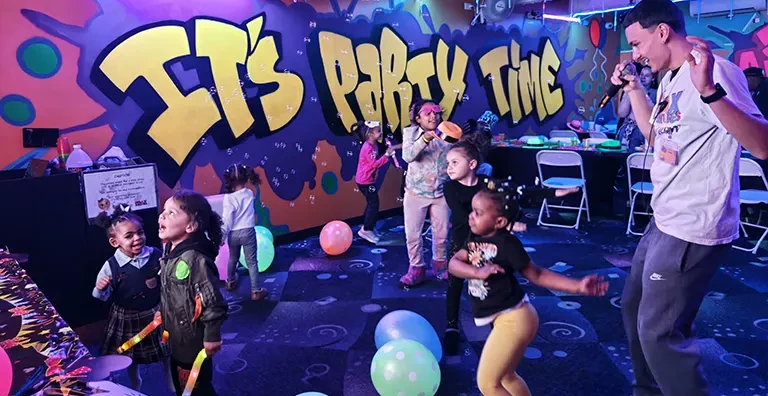
Private vs. Shared Party Venues: Why Brooklyn Parents Are Switching to Private
What parents actually notice at a party
Most parents don’t begin their search thinking about whether a party venue is private or shared. That distinction usually appears later — often after attending a few parties and starting to notice patterns.
At first, the focus is simple:
Is the place fun? Is it clean? Will the kids enjoy it?
But during the event, attention shifts.
It’s usually not one big issue. It’s a series of small moments:
- waiting longer than expected for turns
- trying to gather kids who have drifted into different areas
- adjusting to another group’s schedule without realizing it
None of this feels like a problem on its own. But together, it changes the pace of the party.
And that’s when the question becomes clearer:
Are we hosting this event, or are we sharing it with three other groups at the same time?
The difference between private and shared venues
The terms sound straightforward, but the experience behind them varies more than most parents expect.
| Type of Venue | What It Usually Means | What It Feels Like in Practice |
|---|---|---|
| Shared venue | Multiple parties use the same play areas simultaneously | Movement is less predictable, space feels dynamic but sometimes crowded |
| Semi-private | Private room, shared attractions | Moments of control mixed with moments of waiting |
| Fully private | One group has exclusive use of the entire space | Consistent flow, no interruptions, everything aligned to one schedule |
The important distinction is not just physical access — it’s how many moving parts you’re managing at once.
In shared environments, even well-run ones, there are always overlapping timelines:
- another group arriving
- another cake being served
- another activity starting
Private spaces remove that layer entirely.
What happens inside a shared party environment
Shared venues often work well on paper. They offer variety, flexibility, and a lively atmosphere.
But once the party begins, a different dynamic emerges.
Children don’t follow schedules in a linear way. Some repeat activities, others move quickly between stations, some need more guidance.
When several groups are doing this at the same time, patterns start to overlap:
- popular areas become temporarily congested
- transitions between activities take longer
- staff attention shifts depending on demand
Parents often find themselves stepping in more than expected:
- helping organize movement
- keeping track of where children are
- adjusting timing to fit the environment
It’s not that the venue is doing anything wrong — it’s simply the nature of shared space.
Why private spaces feel different from the start
The difference with private venues is noticeable almost immediately.
There’s no need to figure out where your group fits into the environment. The environment is already built around your group.
That changes the energy of the event.
Instead of reacting to what’s happening around them, both children and parents move through a space that feels predictable.
“What parents usually respond to isn’t just privacy itself,” says Alex, owner of Max Adventures. “It’s the way everything flows when there’s only one group in the space. There’s no need to adjust constantly — and that changes the whole experience.”
Children tend to:
- settle faster
- engage longer with each activity
- feel more confident exploring
Parents tend to:
- step back earlier
- spend less time coordinating
- actually participate in the moment
It’s not about having more features — it’s about having fewer interruptions.
The hidden logistics most parents don’t expect
One of the biggest differences between private and shared venues isn’t visible on a website.
It shows up in logistics.
In shared spaces, coordination becomes part of the experience:
- timing food around other groups
- navigating shared entry and exit flows
- adjusting expectations in real time
Even small delays can ripple through the schedule.
In private venues, those variables are removed:
- start times are clear
- transitions are controlled
- activities can be adjusted based on the group
That consistency reduces pressure — especially for parents hosting larger groups.
How children behave differently in each setting
Children rarely articulate the difference between environments, but their behaviour reflects it clearly.
In shared venues:
- movement is more scattered
- attention shifts more frequently
- group cohesion is harder to maintain
In private spaces:
- children tend to stay more engaged with the group
- activities feel more continuous
- transitions are smoother
This doesn’t mean one is always better — but it does affect how the event unfolds.
For younger children especially, predictability often leads to better engagement.
The role of staff and attention
This is one of the less obvious but most important factors.
In shared environments, staff are typically responsible for multiple groups at once. Even with good systems, their attention is divided.
That can result in:
- slower response times
- less personalized interaction
- more reliance on parents for coordination
In private venues, staff focus on a single group.
That changes the level of involvement:
- instructions are clearer
- activities are better timed
- support feels more immediate
It also reduces the amount of oversight required from parents.
Cost vs. value: what you’re actually paying for
At first glance, shared venues often appear more affordable.
But the comparison isn’t always direct.
| Aspect | Shared Venue | Private Venue |
|---|---|---|
| Base price | Lower entry point | Higher upfront cost |
| Add-ons | Often required for extended time or upgrades | More included upfront |
| Coordination effort | Higher (handled partly by parents) | Lower (handled by venue) |
| Experience consistency | Variable | Stable |
| Overall involvement | Active management | More passive participation |
The difference often comes down to how much responsibility the parent wants to carry during the event.
When shared venues still make sense
Shared venues are not inherently a worse option.
They work well in certain situations:
- smaller, informal gatherings
- shorter events
- children who prefer open, unstructured play
They can also offer a lively atmosphere that some families enjoy.
The key is understanding what kind of experience you’re aiming for — and whether the environment supports it.
How Brooklyn parents are making the decision now
There’s been a noticeable shift in how parents approach party planning.
Instead of focusing primarily on:
- number of attractions
- size of the space
More attention is being given to:
- how manageable the event feels
- how smoothly it runs
- how much involvement is required from the host
That’s where private venues are gaining ground.
They don’t necessarily offer more — but they reduce friction:
- fewer variables to manage
- clearer structure
- more predictable outcomes
For many parents, especially those organizing larger or more structured events, that trade-off becomes worthwhile.
Final thoughts
The choice between private and shared venues isn’t about which one is objectively better.
It’s about what kind of experience you want to create — and how much control you want to have over it.
Shared spaces offer flexibility and energy.
Private spaces offer consistency and focus.
Once parents experience both, the difference becomes easier to recognize.
FAQs
Is a private party venue always better than a shared one?
Not necessarily. It depends on the type of event you’re planning. Private venues are often better for structured parties where coordination matters. Shared venues can work well for more relaxed, informal gatherings where flexibility is preferred.
Why do shared venues sometimes feel more stressful?
Because there are more variables. Multiple groups, overlapping schedules, and shared resources can create small delays or disruptions. These aren’t always obvious beforehand, but they can affect how the event feels overall.
Do kids enjoy private venues more?
In many cases, yes — but not always for the reasons parents expect. It’s less about the space itself and more about the flow. When activities are uninterrupted and the environment is consistent, children tend to stay engaged longer.
Is the higher cost of a private venue justified?
For many families, it is — especially when factoring in reduced stress, smoother coordination, and a more predictable experience. However, for smaller or simpler events, shared venues can still provide good value.
Are private venues suitable for small groups?
Yes, although they are more commonly chosen for medium to larger groups. For smaller parties, the decision usually depends on whether privacy and control are a priority.
What should I ask a venue before booking?
Ask whether the space is fully private, partially shared, or fully shared. Also, clarify how many groups are present at the same time, how staff are allocated, and how the schedule is managed during the event.