
Indoor Birthday Party Games for Kids: Age-by-Age Guide
You can plan three perfectly good party games and still watch the schedule fall apart. One child refuse to join in, another gets upset about losing, and the food arrives just as everybody has finally understood round two.
Usually, the game itself is not a problem.
Good indoor birthday party games for kids need simple rules, a sensible time limit and a way for children with different personalities and abilities to take part. Just as importantly, somebody has to keep the group moving from one game to the next without turning the birthday child's parents into a full-time referee.
The games below are organized by age and are simple enough to run at home or in an indoor party space. Each one includes the basic setup, approximate timing and what you will need, so you can decide quickly whether it suits your group.
Why Game Structure Makes or Breaks a Kids' Party
Children are much more willing to play when they understand the point of the game within the first minute or two. A five-minute explanation for a ten-minute activity rarely ends well.
The rules should be short, the finish should be obvious, and no child should spend half the game standing in a line waiting for a turn. With younger groups especially, games work better when elimination is avoided. Once somebody is "out," you still must keep that child occupied while everybody else continues.
A time limit helps too. Ending a game while children are still enjoying it makes the next activity easier to introduce than waiting until interest has already disappeared.
For mixed groups, choosing games where being taller, faster or more experienced does not determine every result. A small prize, team cheer or funny group finish can provide the celebration moment without making winning the only reason to participate.
Indoor Birthday Party Games for Toddlers (Ages 2–4)
For toddlers, eight to ten minutes is plenty for most games. Keep instructions extremely simple and avoid long turns, elimination and anything that depends on children remembering several rules at once.
Musical Spots
Place large colored circles, mats or sheets of paper around the floor. Children move or dance while music plays and find any available spot when it stops. Nobody is removed from the game.
Players: 3 or more
Time: 5–8 minutes
You need: Music and floor spots or mats
Unlike traditional musical chairs, Musical Spots avoids chairs being pulled away and keeps every child involved until the end.
Bubble Chase
One adult blows bubble across a clear play area while children chase and pop them. You can occasionally ask everyone to freeze while more bubbles are prepared, but the game does not need scoring.
Players: Any small group
Time: 5–8 minutes
You need: Bubble solution and a wand or bubble machine
Keep the floor clear and check for slippery patches if bubble solution lands heavily in one area.
Balloon Tap
Give the group one or two lightweight balloons and ask them to keep the balloons from touching the floor using their hands.
Players: 2–8 per balloon
Time: 5–8 minutes
You need: Inflated balloons
There is no need to count points. At this age, simply keeping the balloon moving is enough. Adults should supervise closely and remove any burst balloon pieces immediately.
Sticker Hunt
Place large stickers or simple picture cards in easy-to-see locations around the room. Children search for one at a time and bring their finds back to a central spot.
Players: 3–10
Time: 5–10 minutes
You need: Large stickers or picture cards
Keep everything at toddler height and avoid hiding items behind furniture or anywhere children need to climb.
Follow-the-Leader Circle
An adult leads a simple sequence such as clap, stomp, turn around, reach up and sit down. Children copy the actions together.
Players: 3 or more
Time: 5–8 minutes
You need: Nothing
It works particularly well near the end of a more energetic activity because the pace can gradually become calmer.
For parents who prefer built-in movement rather than running several toddler games themselves, Max Adventures has a toddler play setup with a castle bounce house and other age-appropriate play elements.
Birthday Party Games for Kids Ages 5–7
By five or six, children can follow a little more structure and usually enjoy friendly competition. They still need games to move quickly, though, and it helps if the celebration includes moments where everybody gets to succeed rather than one child collecting every prize.
Freeze Dance
Play music while everyone dances. When the music stops, players freeze. Instead of removing children who move, ask them to do a funny action before rejoining.
Players: 4 or more
Time: 8–10 minutes
You need: Music
Keeping eliminated players in the game prevents the familiar problem of half the party sitting down after the first few rounds.
Hot Potato
Children sit or stand in a circle and pass a soft object while music plays. When the music stops, the person holding it chooses the next funny action, dance move or sound for the group to copy.
Players: 5–12
Time: 8–10 minutes
You need: Music and one soft object
This version keeps the suspense of Hot Potato without making children leave the circle.
Obstacle Course Relay
Create a short indoor route using cones, cushions, hoops or other safe markers. Children move through it one at a time or in small teams.
Players: 4–12
Time: 10–12 minutes
You need: Cones, hoops or safe household markers
Keep the course simple enough that nobody needs a demonstration halfway through. At a venue, built-in play equipment can create the same effect without parents constructing a course from scratch.
Copycat Leader
One child or adult performs three simple movements, such as clap twice, jump once and turn around. The group copies the sequence, then another leader takes over.
Players: 4 or more
Time: 8–10 minutes
You need: Nothing
It works well for children who enjoy performing but does not depend on speed or athletic ability.
Picture Trivia Teams
Split the group into small teams and ask easy questions based on animals, cartoons, colors, familiar objects or whatever the birthday child enjoys. Younger readers can answer from pictures instead of written questions.
Players: 6–15
Time: 10 minutes
You need: Prepared questions or picture cards
Keep the questions broad enough that every team gets some right. The purpose is the team reaction, not testing what children know.
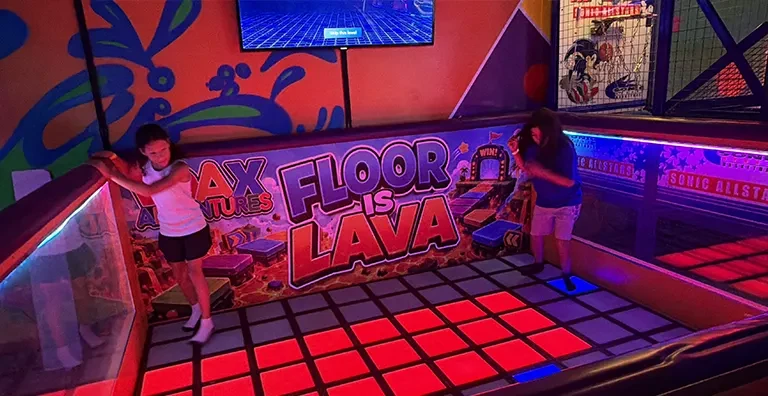
At Max Adventures, children in this age range can also move into attractions such as the bounce house, Super Block interactive floor and the GaGa Ball arena. Parents looking specifically for slower, problem-solving activities can find those separately in our guide to indoor strategy games for kids.
Indoor Party Games for Kids Ages 8–12
Older kids usually want more freedom, stronger competition and fewer games that feel as though an adult designed them for small children. Team formats tend to work well because friends become part of the challenge.
Scavenger Hunt
Hide a manageable number of clues or objects around the approved party space and divide children into teams. Each clue leads to the next until one team reaches the finish.
Players: 6–16
Time: 15–20 minutes
You need: Clues or hidden objects
Keep the search within clearly defined areas so children are not opening cabinets, entering staff spaces or moving furniture.
Team Relay Challenge
Create two or three short tasks and let teams complete them in sequence. The tasks might involve carrying an object, moving around markers or completing a simple physical action.
Players: 6–16
Time: 12–15 minutes
You need: Equipment suited to the chosen tasks
Short rounds are better than complicated relays with six different stages. Children should understand the entire challenge before it begins.
Trivia Tournament
Run several fast rounds around music, movies, animals, pop culture or the birthday child's interests. Teams write or call out answers and scores are kept across the rounds.
Players: 6–20
Time: 15–20 minutes
You need: Questions and a way to record scores
Keep categories mixed so one child does not dominate because the entire quiz happens to match a single hobby.
Laser Tag Rounds
At a venue with a dedicated setup, short team rounds give older children the competition they often want without parents having to create the game mechanics themselves.
Players: Depends on the venue setup
Time: 10–15 minutes per rotation
You need: Venue equipment
The venue's own instructions and supervision should determine how the game is played.
GaGa Ball
GaGa Ball is another strong group option for this age because children stay alert to what everybody else is doing rather than waiting through individual turns. At Max Adventures, it is run in a dedicated area, so there is no need to build a temporary playing area.
For more ideas aimed specifically at the upper end of this group, see our birthday party ideas for 9–13-year-olds. We also have a separate guide to birthday party games for tweens and teens, rather than stretching younger children's games into an age group they no longer suit.
How to Run Party Games Without Chaos: Timing and Flow
A good sequence matters almost as much as the individual games.
Start with something active and easy to understand. Guests are arriving with energy, and some children will still be settling into the group. A movement game gives them something to do without demanding much conversation or concentration.
Once everyone is involved, move into a game with a little more structure. Later in the party, a quieter group activity can give children a break before the final high-energy round.
Transitions need attention as well. Give a two-minute warning before a game end rather than stopping it without notice. Have one adult act as the game leader, even if several adults are helping. Children respond much better when instructions come from one person.
It also helps to explain the next activity while the children are already gathered. If they are sitting in a circle after Hot Potato, that is the moment to explain what happens next, not after they have scattered across the room.
Avoid filling every minute. A short drink break or a couple of minutes to regroup can prevent the next game from starting with children already distracted.
When You Want Someone Else to Run the Games
Some parents enjoy running the party. Others would rather spend their child's birthday watching the games than explaining them.
Max Adventures at 2378 Flatbush Avenue, Brooklyn, NY 11234 is set up for the second group. Parties are private, so the venue is reserved for your guests, and staff manage the games, activity rotations and transitions rather than handing parents a space and leaving them to organize the entertainment themselves. The current party setup also includes access to all 14 attractions.
Alex R., founder of Max Adventures, has a simple explanation for why those transitions get so much attention:
"The game is almost never the problem. The problem is the gap between games, those two minutes where nobody knows what's happening. We train our staff to close that gap completely."
That difference is easy to underestimate until you have tried getting a dozen excited children to stop one activity, listen to a new set of instructions and move together into the next one.
For families who would prefer the games and party flow to be handled on-site, the current birthday party packages show how the private-party format works.
FAQs
What are the best indoor birthday party games for 5-year-olds?
Good indoor birthday party games for 5-year-olds include Freeze Dance, Hot Potato without elimination, simple obstacle relays, Copycat Leader and easy team trivia. Games should have short instructions and usually run for about 8 to 12 minutes. At this age, mild competition can be fun, but keeping every child involved generally works better than eliminating players after each round.
How do I keep birthday party games fair for different ages?
Birthday party games for mixed ages are fairer when success does not depend entirely on speed, height or strength. Team games, dancing, scavenger hunts and activities with several ways to participate work particularly well. Avoid long elimination rounds, mix older and younger children across teams when appropriate, and use small celebration moments for the whole group rather than rewarding only one winner.
What indoor birthday party games work for a private venue in NYC?
Indoor birthday party games that work well in a private NYC venue include Freeze Dance, scavenger hunts, team relays, trivia, obstacle challenges, Laser Tag and GaGa Ball. The best choices depend on the children's age and the equipment available at the venue. A private setup also makes it easier to keep the guest group together and move directly between games without sharing activity areas with unrelated visitors.