
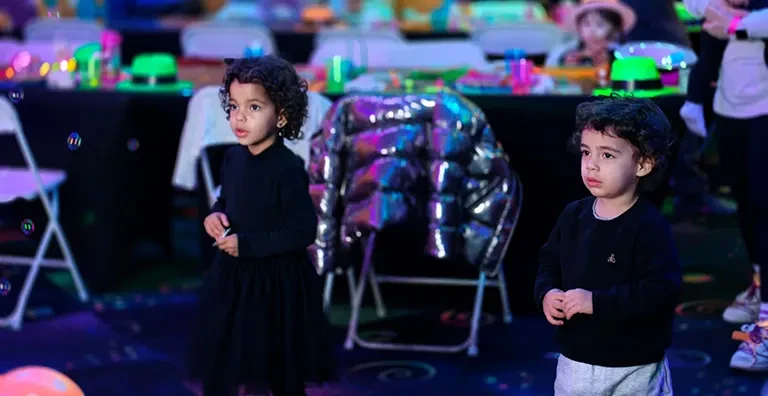
How to Plan a Fun and Stress-Free Birthday Party for 2–4 Year Olds in Brooklyn
Indoor Guide for Parents
Planning a birthday party for a 2–4 year old in Brooklyn requires short activity blocks, a safe indoor layout, predictable transitions, and calm supervision. Toddlers and young preschoolers thrive in structured, sensory-friendly environments with limited guest lists and clear flow. Indoor private venues in Brooklyn reduce weather risks and overstimulation, helping both children and parents enjoy the day.
Table of Contents
1. Why Ages 2–4 Require a Different Party Approach
2. Guest List and Timing Guidelines
3. Indoor Venue Selection in Brooklyn
4. Development-Appropriate Activities
5. Food and Allergy Considerations
6. Managing Transitions and Meltdowns
7. Sample 90-Minute Party Timeline
8. Safety and Supervision Standards
9. Real Planning Example from Brooklyn Families
10. Checklist for Parents
11. Frequently Asked Questions
Why Ages 2–4 Require a Different Party Approach
Children between ages two and four are in a period of rapid cognitive and emotional development. According to the U.S. Centers for Disease Control and Prevention, children in this age group are developing impulse control, language skills, and early social interaction patterns. Attention spans are typically short. Two-year-olds may focus for 5–8 minutes per activity. Three- and four-year-olds may sustain engagement slightly longer.
Dr. Laura Mitchell, a pediatric occupational therapist with 18 years of experience working with preschool children in New York, notes:
“At ages two to four, children respond best to predictable structure. Overly packed party schedules or loud, chaotic environments often result in overstimulation.”
A successful toddler party is not about volume. It is about pacing.
Guest List and Timing Guidelines
Recommended Guest Count
| Child's Age | Suggested Number of Guests |
|---|---|
| 2 years | 4-6 children |
| 3 years | 6-8 children |
| 4 years | 8-10 children |
Smaller groups reduce overstimulation and make supervision manageable.
Ideal Party Duration
| Age | Ideal Length |
|---|---|
| 2 years | 60-75 minutes |
| 3-4 years | 90 minutes |
Longer events increase fatigue and emotional regulation challenges.
Indoor Venue Selection in Brooklyn
Brooklyn weather can be unpredictable. Indoor private party spaces reduce stress related to rain, wind, or extreme temperatures.
When evaluating an indoor venue, parents should look for:
- Fully private party rooms
- Soft play areas suitable for toddlers
- Clear separation between active and food zones
- On-site staff supervision
- Safe flooring and padded equipment
Max Adventures in Brooklyn has hosted hundreds of preschool-age celebrations over the years. Their team reports that fully private indoor formats reduce overstimulation and allow children to explore freely without crowd interference.
Parents consistently cite three benefits:
1. Weather independence
2. Structured activity rotation
3. Staff-led organization
Development-Appropriate Activities
Activities should focus on gross motor play, simple sensory exploration, and imaginative engagement.
Suitable Activity Types
| Activity Type | Why It Works for Ages 2–4 |
|---|---|
| Soft Play Gym | Supports balance and motor development |
| Block Building | Encourages cooperation and fine motor skills |
| Light-based Games | Visually engaging without complexity |
| Simple Obstacle Courses | Develop coordination safely |
| Parent-Child Dance Time | Builds emotional bonding |
Avoid competitive games or complex rules. At this age, parallel play is common. Not all children will play together, and that is developmentally normal.
According to the American Academy of Pediatrics, active play in early childhood supports cognitive and social development. Structured indoor play environments can enhance these benefits when supervised appropriately.
Source: American Academy of Pediatrics, HealthyChildren.org
Food and Allergy Considerations
Brooklyn families are increasingly mindful of allergies. CDC data shows that approximately 8 percent of children in the U.S. have food allergies.
Best practices:
- Ask parents about allergies in advance
- Keep menu simple
- Avoid choking hazards such as whole grapes or hard candies
- Provide water stations
Finger foods are ideal. Keep sugar levels moderate to avoid energy spikes followed by fatigue.
Managing Transitions and Meltdowns
Transitions are the most sensitive moments during toddler parties.
Common triggers:
- Moving from play to food
- Waiting for cake
- End-of-party departures
Strategies that experienced planners use:
- Announce transitions five minutes in advance
- Use visual cues
- Keep cake presentation short
- Offer quiet corner seating
Dr. Mitchell shares that many meltdowns are not behavioral problems but fatigue signals.
Shorter parties reduce this risk.
Sample 90-Minute Indoor Party Timeline
| Time | Activity |
|---|---|
| 0-15 min | Arrival and free soft play |
| 15-35 min | Guided play rotation |
| 35-50 min | Light group activity |
| 50-65 min | Food break |
| 65-75 min | Cake celebration |
| 75-90 min | Calm free play and departures |
This structure balances activity with rest.
Safety and Supervision Standards
Parents should confirm:
- Staff-to-child ratio
- First aid training
- Clearly marked emergency exits
- Cleanliness standards
Dr. Mitchell shares that many meltdowns are not behavioral problems but fatigue signals.
Shorter parties reduce this risk.
Max Adventures’ event coordinators, with over a decade of experience managing children’s events in Brooklyn, report that structured supervision significantly reduces minor injuries and crowd congestion.
Clear supervision reduces parental anxiety. Parents can participate rather than constantly monitor.
Real Planning Example from Brooklyn Families
A Park Slope family recently hosted a 3-year-old birthday celebration indoors after cancelling an outdoor playground plan due to forecasted rain.
Key adjustments:
- Reduced guest list from 15 to 8 children
- Shortened party to 90 minutes
- Eliminated loud character performers
- Focused on structured soft play
Parents reported fewer tears, smoother transitions, and calmer departure.
The primary lesson was simple: developmental pacing matters more than scale.
Checklist for Parents
Before booking:
- Confirm private indoor space
- Verify supervision policies
- Ask about toddler-safe equipment
- Plan simple menu
- Keep guest list manageable
- Schedule for late morning or early afternoonPlan simple menu
Frequently Asked Questions
Is two years old too young for a party?
Not at all. Keep it short, familiar, and small. Many families choose a 60-minute indoor format.
What time of day works best?
Late morning between 10:30 a.m. and 12:00 p.m. aligns with toddler energy cycles.
Should siblings be included?
Yes, but count them toward total guest capacity to avoid overcrowding.
Is indoor better than outdoor in Brooklyn?
For this age group, indoor private spaces provide predictable structure and weather security.
Final Thoughts
A successful birthday party for ages 2–4 is calm, short, and developmentally aligned. It is not defined by scale or extravagance. It is defined by structure, safety, and manageable stimulation.
If you are planning a toddler birthday party in Brooklyn and want a private indoor setting designed for young children, explore available party packages at Max Adventures. Their team can guide you through scheduling, activity flow, and safety planning.
For more planning guides tailored to Brooklyn families, visit the Max Adventures blog.
Have a question about organizing a toddler party? Leave a comment or contact the team for personalized advice.