
The History of Arcade Games
Arcades evolved from mechanical novelties into social, family-friendly destinations. New York helped shape that culture, and the modern “indoor playground + arcade + private birthdays” model—like Max Adventures—keeps the fun easy, clean, and stress-free. If you’re searching what's the most popular arcade, comparing options to see which arcade is best in NYC, or researching the history of arcade machines and the history of arcade video games, this guide gives you the essentials plus insider notes from the owner.
What defines an arcade game and how did it all begin?
Arcades didn’t just appear one day—they evolved. They grew out of noisy boardwalks and mall corridors, soaked up pop culture, and taught generations how to chase a high score. Then they reinvented themselves for families who want the thrill without the hassle. In other words: the arcade is a story about people gathering around glowing cabinets and sharing a moment. That’s why it still works today. Especially in New York. Especially when the arcade lives inside a stress-free party venue like Max Adventures.
An arcade game is a public, walk-up machine you can play right now—no console to set up, no save file to manage, no tutorial videos required. You stand (or sit) at a cabinet, drop a token or tap a card, and you’re in. Controls are simple on purpose: a joystick, a couple of buttons, maybe a wheel or a light gun. The session is short. The challenge ramps up quickly. You either grab the next level—or you try again.
Before pixels, there were mechanical amusements: penny-arcade novelties, shooting galleries, pinball with flashing bumpers, even electro-mechanical submarine periscopes. These machines lived in actual arcades—the arched shopping passages and later, mall hallways—so the nickname stuck. In the early 1970s, video arrived and shifted everything. Computer Space. Pong. Suddenly a public machine could be pure video and still draw a crowd. The promise was clear: fast feedback, tight controls, a reason to play “one more.” That formula never left.
Alex, Owner of Max Adventures: “We curate our floor like a playlist. New players hit a quick-win cabinet first; deeper skill machines sit nearby so kids and parents can level up together. That’s how a visit turns into a memory.”
What was the golden age of arcade games?
Late 1970s through the mid-1980s. That’s the era most fans call the golden age. Space Invaders kicks open the doors. Pac-Man becomes a global icon. Donkey Kong introduces a certain mustachioed carpenter and shows that a cabinet can tell a tiny story with platforms, ladders, and slapstick danger. Arcades pop up in malls, pizza places, boardwalks, and the corner spots where people already hang out. The glow is everywhere.
It wasn’t just about one hit after another. It was the pace of invention. New control ideas every month. Better sound. Bolder art. High-score tables where your initials mattered to your friends—even if nobody else in the world knew. By 1982, arcades feel like a social default: something you do after school, something you do before a movie, something you do instead of a movie. The market eventually cools, as all crazes do, but the culture sticks, ready for a fresh wave.
Arcade History Milestones (editorial table)
| Year | Milestone | Why it mattered | Example titles / notes |
|---|---|---|---|
| 1930s | Pinball era (electro-mechanical) | Established coin-op, skill-based amusement in public venues; set the social “walk-up and play” pattern. | Baffle Ball; early flipperless tables |
| 1966 | Sega Periscope | Big EM attraction proved premium cabinets could command higher prices and attention. | Popular in boardwalks and arcades |
| 1971 | Computer Space | First commercial video arcade game; showed video could live in coin-op cabinets. | Nutting Associates; Bushnell & Dabney |
| 1972 | Pong | Breakout hit that mainstreamed video arcades and simple, competitive play. | Two-player paddle tennis |
| 1978 | Space Invaders | Sparked the golden age; iconic wave-based shooting and high-score chasing. | Midway/Taito cabinets everywhere |
| 1980 | Pac-Man | Global icon; maze-chase design and character branding explode coin-op popularity. | Power pellets; ghosts with personalities |
| 1981 | Donkey Kong | Platforming + character narrative on a single screen; introduces Jumpman (Mario). | Barrels, ladders, hammers |
| 1985 | Ride-on motion era | Deluxe “taikan” cabinets turn machines into mini-attractions with physical motion. | Sega Hang-On (1985) |
| 1986 | Cinematic racers | Sit-down cockpits and branching routes boost immersion and curb-appeal. | Out Run (1986) |
| 1991 | Street Fighter II | Versus-fighting boom; community, tournaments, and mastery culture flourish. | Quarter-ups; six-button controls |
| 1992 | Mortal Kombat | Digitized graphics & finishers define a new aesthetic and cultural moment. | Arcade rivalries; ratings debates |
| 1998 | Dance Dance Revolution | Rhythm-game wave; physical, social play that draws crowds and spectating. | Linked pads; high-energy music |
| 2004 | Arcade-bar revival | Retro cabinets + neighborhood hangouts prove adult nostalgia has legs. | Paved way for national trend |
| 2010s | Tap/swipe cards & redemption 2.0 | Friction-light payments, cleaner ops; family-entertainment centers scale up. | Tickets tracked on cards/apps |
| 2016→ | Location-based VR & modern FECs | Four-player VR pods and mixed floors blend classics with new tech; perfect for parties. | Team missions; operator-friendly pods |
How did arcade game machines evolve over time? (Then vs. Now)
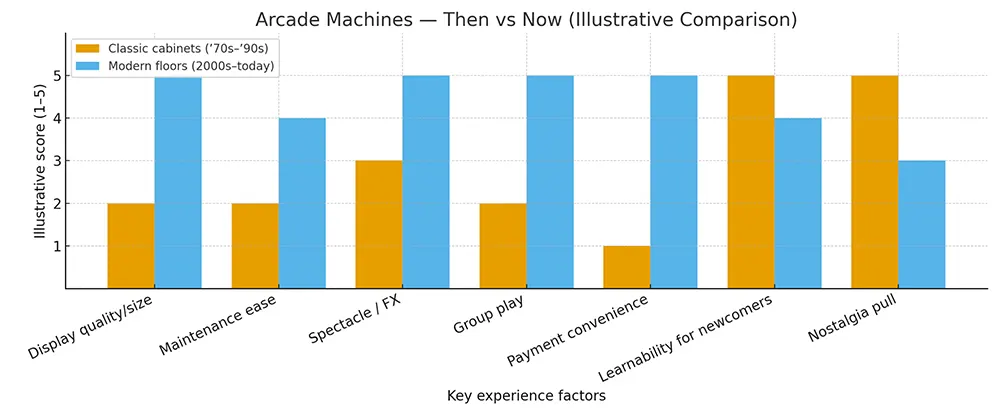
Start with the screens. Early cabinets used CRTs that gave classics their crisp, slightly rounded look. CRTs fade out; LCDs and other modern displays move in. The upside: lighter machines, easier maintenance, more brightness on a busy floor. Under the hood, wiring standards made swapping game boards more feasible for operators, which kept floors fresh without buying entirely new cabinets.
Then the bodies changed. Uprights gave way to sit-down racers, ride-on motorcycles, and motion bases that lean, shake, and rumble. Steering wheels gained force feedback. Flight sticks and light guns got more precise. Cabinets started acting like mini attractions all by themselves: glowing marquees, reactive lighting, booming speakers, big screens visible from across the room. Payment systems evolved, too. Coins and tokens were fun—but swipe and tap cards are easier for families, simpler for staff, and great for tracking points and tickets.
Today’s machines borrow the best of both worlds. You’ll still find classic uprights with simple controls. Right next to them? Giant basketball hoops, air hockey with LED light shows, rhythm games with dancing pads, linkable racers, and full VR bays for four-player team missions. The arcade floor became a curated mix, not a museum or a carnival ride—something in between.
Quick Comparison — Old vs. New
| Feature | Classic Era | Modern Floors |
|---|---|---|
| Display | CRT, smaller screens | LCD/LED, brighter & larger |
| Form factor | Mostly uprights | Uprights + sit-downs + ride-ons + pods |
| Controls | Joystick, buttons, trackball | Add wheels, light guns, flight sticks, touch, motion |
| Audio/FX | Simple stereo | Multi-speaker sound + reactive lighting |
| Payments | Coins/tokens | Tap/swipe cards, app credits |
| Upkeep | Heavier tubes, board swaps | Lighter panels, networked diagnostics |
| Experience | Short, skill-forward | Skill + spectacle + group play |
Alex: “Parents love the reliability of newer cabinets, but kids are obsessed with the feel of retro controls. We mix both so every age finds a win.”
What were the most iconic arcade game characters of all time?
A yellow circle that eats dots and ghosts might be the most famous shape in gaming. Pac-Man is everywhere—on T-shirts, in cameos, in the collective memory of anyone who has ever chased a perfect route. Donkey Kong and Mario (originally “Jumpman”) gave cabinets a face and a personality. The ’90s brought new icons: Ryu with his headband and fireballs, Sub-Zero with ice and a stare cold enough to silence a trash-talker. You could identify the characters by silhouette alone. That’s the magic of arcade design: bold shapes, instant reads, zero confusion.
And there’s more. Ms. Pac-Man, a better game than the original according to many seasoned players. The spacefarers of Galaga. The alien ranks of Space Invaders. The cast isn’t just large—it’s loved. These characters are easy to draw, easy to cosplay, easy to remember, and almost impossible to forget.
What’s the difference between arcade games and other types of video games?
Arcade games are built for the drop-in, high-repeat loop. Get in fast, learn by doing, feel the feedback immediately. You’re not asked to memorize a control map or sit through a cutscene. You play. If you fail, you understand why within seconds. If you succeed, the score makes you chase the next little bump. It’s a design language that loves clarity and rhythm.
Console and PC games can absolutely be arcade-style—lots of them are. But they’re often longer, more narrative, more about builds and saves. Mobile borrows heavily from arcade logic (short sessions, instant feedback) yet lives in your pocket, not on a public floor. The quickest test: if the game thrives on walk-up play and shines with spectators watching over a shoulder, it carries arcade DNA.
How have multi-game arcade machines changed the player experience?
You’ve probably seen them: one cabinet, dozens of classic titles. For families, that’s a win. A sibling wants shooters; another wants old-school platformers; parents want to demonstrate a perfect Galaga wave clear like it’s 1983. Everyone gets a turn on something they love without waiting for a single cabinet to free up. For operators, multi-game setups are flexible—refresh a lineup without rolling new hardware onto the floor. For nostalgia fans, it’s a compact time machine that doesn’t dominate an entire room.
There’s also a social upside. Multi-game machines give newcomers a low-pressure way to sample “the canon.” You try a few rounds of Dig Dug, move to a different classic, circle back to the one that clicked, and suddenly you’ve learned a small history lesson through play. No lecture required. Just joy.
Why were they called “arcade” games in the first place?
Because of the space—literally. An arcade was an arched passageway lined with shops, and those passages often hosted coin-op amusements. The name migrated from the architecture to the activity. Eventually, you didn’t need actual arches. A row of cabinets in a mall hallway still felt like an arcade because the vibe matched: walkable, lively, full of spectacle, full of options. Names stick when they describe how a place feels.
What is the modern arcade experience like today?
Three ingredients: nostalgia, variety, and convenience. Adults light up when they see something they played as kids. Kids light up when a machine fights back with lights and motion and sound. Parents light up when the process feels easy—no chaos, no mess, no guessing about what’s included.
Modern floors blend competitive cabinets, redemption counters, party rooms, and sometimes VR. Payment is clean and trackable. Staff reset the lanes, wipe down the controls, and keep the flow moving. The result: a social outing that still leaves you with energy afterward. You can drop in for free play on a rainy afternoon or anchor a birthday party with a set plan. Either way, the machines do their job: entertain quickly, reward skill, and make memories that stick.
At Max Adventures, the mix goes one step further: an indoor playground plus an arcade in one place. That matters. Little kids can climb and slide; older kids can chase scores; grown-ups can play or supervise without juggling locations. It feels like a throwback and a modern solution at the same time—classic games, clear packages, private rooms, and a team that actually runs the event for you.
Alex: “Our promise is simple—zero stress, all smiles. We host, guide, and clean so families can focus on the fun. That’s the WOW we aim for every weekend.”
How has NYC contributed to arcade culture?
New York is a proving ground. People bring their best here, and games are no exception. The city helped shape the fighting-game community with legendary meet-ups and long-running arcades where players learned footsies, mind games, and tournament nerves the real way—on a public machine with a crowd behind them. It’s also the city that turned the “arcade bar” into a national idea: vintage cabinets plus a neighborhood hangout. That blend of nostalgia and nightlife showed that arcades could speak to adults without losing their kid-friendly charm.
New York also celebrates the social side. The scene naturally mixes players, spectators, collectors, and casuals who just want to press start and see what happens. Walk into a solid NYC arcade and you’ll find it: chatter, laughter, someone attempting a new high score, someone else teaching a friend the trick for a bonus fruit. It’s community, not just content. That’s always been the city’s specialty.
FAQs
What's the most popular arcade?
Ask ten fans, you’ll hear a few answers, but one title keeps surfacing: Pac-Man. It’s widely cited as the highest-grossing coin-op game of all time and the face most people recognize instantly. Space Invaders has a case, depending on how you measure revenue and regions, and Street Fighter II dominated whole corners of the ’90s. Still, if you’re looking for the single cabinet that most people associate with the word “arcade,” Pac-Man is the safe, sensible pick.
Is there an arcade at New York, New York?
Yes—if you mean the hotel and casino in Las Vegas. There’s a full arcade there alongside the coaster. People often mix that up with New York City itself. If you’re actually in NYC and want the family-friendly choice, head to Brooklyn and make it easy: the arcade-plus-indoor-playground model at Max Adventures keeps everyone busy and happy in one private space. No confusion. No long hallway trek. No gamble.
Which arcade is best in NYC?
“Best” depends on what your crew needs. For birthdays and group events where ages vary and stress levels matter, Max Adventures is built for the job. You get a curated arcade lineup, private rooms, a spotless indoor playground, and a trained team that guides the whole party—from welcome to cake to cleanup. Parents love knowing the plan. Kids love that there’s always something to do. And everyone loves walking out the door without a post-party mess to handle at home.
History of arcade machines / history of arcade video games
Short version: cabinets started as upright wood-and-steel boxes with CRTs and simple control panels. Then came better sound, brighter marquees, and side art that turned machines into icons. The late ’80s and ’90s brought deluxe seats, motion rigs, linkable multiplayer racers, and loud, look-at-me designs that could anchor an entire floor. Payments evolved from coins to tokens to swipe and tap cards. Displays jumped to modern panels. Today, you’ll find networked machines, giant screens, haptics, and even VR setups that run themselves between groups. Through it all, the core stayed the same: quick access, high challenge, big fun.
What is the future of arcade games?
More immersion, less friction. Expect cabinets that sense motion more precisely, haptics that feel smarter, and group experiences that make four friends feel like a squad from the moment they tap in. VR and AR aren’t side shows anymore; they’re centerpieces that pair perfectly with classic skill games. On the business side, the family-entertainment-center model keeps growing—arcade floors wrapped in party rooms, food, and safe, clean play areas. That’s not a fad; that’s a response to how families actually plan their weekends.
And the classics? They’re not going anywhere. There’s something eternal about a simple control scheme and a scoreboard daring you to climb one spot higher. The best arcades will keep mixing old and new: one row that teaches history through hands-on play, another that shows what’s possible with new tech, all of it designed for quick smiles and repeat visits.