
Birthday Party Activities for Kids: Ideas for Every Age
Put ten children in one room and they will not all want to do the same thing for very long. One will head straight for anything they can climb. Another may need a few minutes before joining in. Younger guests often change direction quickly, while older children are more likely to stay interested when there is a challenge involved.
That is the real job of birthday party activities for kids. They need to keep the group occupied without making the celebration feel like a tightly managed class schedule.
A good party usually mixes movement with something more social or creative, then changes pace before children begin to lose interest. You do not need a huge activity list. A few well-chosen options, matched to the children's age and given enough time to work, are usually far more useful.
What Makes a Birthday Party Activity Work for Kids
The best activity is not necessarily the most elaborate one. Children tend to respond better when they quickly understand what is happening and can join in without a long explanation.
Age is the first consideration. A toddler may be perfectly happy chasing bubbles, while an eight-year-old will usually expect more of a challenge. Attention span matters too. If children have begun wandering off, stretching the activity for another ten minutes rarely brings them back.
Activities should also allow for different levels of confidence and ability. Birthday guests will not all be equally athletic, outgoing or competitive, so it helps when everyone has a realistic way to participate.
Finally, children should be able to tell when an activity begins and ends. That little bit of structure makes transitions much easier.
Parents looking for help with the rest of the event can use our kids birthday party planning checklist for the broader planning details.
Types of Birthday Party Activities (and Why You Need a Mix)
Most parties work better when the children are not asked to stay at the same energy level from beginning to end.
Physical activities give them somewhere to put the excitement they arrive with. Running, climbing, bouncing and movement challenges are obvious choices. Max Adventures' Soft Play Gym is an example of this type of activity already built into the venue.
Creative activities offer a useful change of rhythm. An art table, building station, dressing-up area or photo activity can keep children involved without another round of running. The Photo Booth at Max Adventures fills a similar role, particularly when friends want to take pictures together.
Competitive activities become more appealing as children get older. They might race against a clock, try to improve a score or complete a challenge. The Laser Maze gives children that kind of goal without requiring parents to invent a competition themselves.
Social activities work because the fun comes from doing something together. Music and dancing are simple examples. Put them into a glow-in-the-dark room and an ordinary dance break suddenly feels much more like part of the birthday celebration.
There is no need to divide the party evenly between all four categories. Variety matters more. Children are much less likely to drift away when the next activity feels noticeably different from the last one.
Birthday Party Activities by Age Group
Age ranges are only a guide, but they are useful when deciding how long an activity should last and how complicated it can be.
Toddlers & Young Kids (Ages 2–4)
Soft play or bouncing, about 8 to 12 minutes. Younger children can climb, crawl and move at their own pace without having to remember rules. Choose equipment designed for their age and keep an adult nearby while they play.
Bubble play, about 5 to 10 minutes. Toddlers rarely need instructions when bubbles appear. Give them clear enough space to chase and pop them and watch for spilled bubble solutions on the floor.
Music and movement, about 8 to 10 minutes. Familiar songs, simple actions and dancing work well because children can copy what they see without waiting for a turn. There is little benefit in adding winners or elimination at this age.
Photo and dress-up play, about 5 to 10 minutes. Large hats, glasses and other age-appropriate props provide calmer activity between more energetic periods. Small accessories should be avoided with children who may still put objects in their mouths.
For celebrations where most guests are very young, our guide to birthday parties for 2–4-year-olds in Brooklyn looks more closely at this age group.
Kids (Ages 5–7)
Children between five and seven can handle a little more structure, but they still want to get started quickly.
Obstacle-style activities, about 10 to 15 minutes. A short course involving climbing, stepping or moving around obstacles gives the group an obvious goal. Keep it achievable for the least confident children rather than design it around the fastest guest.
Interactive floor activities, about 10 to 15 minutes. Lights, colors and movement cues can hold attention without requiring much explanation. Max Adventures' Super Block uses an interactive LED floor to create this kind of physical challenge.
Dancing and music, for about 10 minutes. Children can follow movements, create their own or take turns choosing what everyone does next. It also provides a useful reset after climbing or racing around.
Photo booth time, about 8 to 10 minutes. Small groups can choose props and pose together while the rest of the party changes pace. Because the activity is social rather than competitive, quieter children often find it easier to join.
At this age, clear instruction followed by immediate action generally works better than several minutes spent explaining what children are about to do.
Older Kids (Ages 8–12)
Older children are usually ready for longer rotations and activities with more of a goal behind them.
Laser Maze, about 15 to 20 minutes. A mission-style challenge gives children something concrete to complete and makes the result part of the fun. Any venue instructions should be followed before children begin.
GaGa Ball or another group challenge, about 15 to 20 minutes. Older children often enjoy activities where their friends affect what happens next. Group play also keeps more guests involved at the same time.
Virtual reality, about 10 to 20 minutes. VR can add something very different to an otherwise physical party. It works best as part of a rotation, so children do not spend too long waiting for equipment.
Arcade or gaming time, about 15 to 20 minutes. This age group often appreciates some freedom to choose what they play and who they play with rather than being directed through every minute of the party.
Parents organizing a celebration for children toward the upper end of this group can find more specific birthday party ideas for 9–13-year-olds.
How Many Activities Does a Kids Party Actually Need?
For an hour of activity time, two or three good options will usually be enough. For a two-hour party, four or five activities leave room for more variety without turning the event into a race through a schedule.
Young children need the quickest changes. Around 10 to 12 minutes is a sensible starting point for toddlers. By the time children reach their elementary years, they can often stay with an activity for 15 to 20 minutes, particularly when friends are involved or there is a challenge to complete.
Parents also tend to underestimate the time between activities. Children need to stop what they are doing, come back together, listen to what happens next and physically move to another area. Even a smooth transition takes time.
This is where structured indoor birthday party activities can make the day easier. At Max Adventures, staff manage the rotations and move children from one part of the experience to the next, so parents are not repeatedly trying to round up the group themselves.
Birthday Party Activities at Max Adventures: Everything Included
For families who would rather not source four or five activities, set them up and then spend the party running them, Max Adventures has the entertainment already inside the venue.
The private facility at 2378 Flatbush Avenue, Brooklyn, NY 11234 has 14 attractions, and the useful part is that they are not all versions of the same activity.
Children who want active physical play can use the Soft Play Gym; Toddler Play area and Ball Pit/GaGa Ball Arena.
The challenge-based attractions include Laser Maze, Laser Tag, Axe Throwing and Super Block/Floor Is Lava, the interactive LED floor activity.
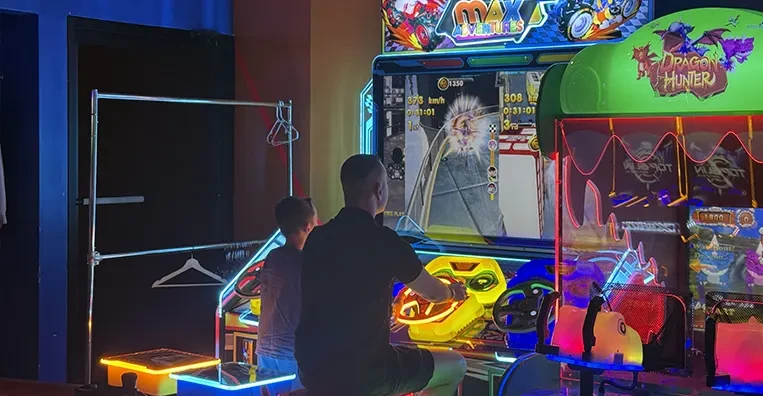
For children interested in gaming and technology, there is Virtual Reality, Arcade Games and the Gaming Room.
The social and party side includes the Glow in the Dark Party space, Photo Booth and Pie in the Face Game. The Parent Lounge completes the current list of attractions and gives adults a separate place within the venue while the children's rotations continue.
Parents can look through all 14 attractions before deciding how the venue fits the kind of party their child would enjoy.
The building is booked privately for each event rather than operating as an open-play space, and Max Adventures staff handle the games and transitions. That changes the experience for parents. Instead of introducing each new activity, explaining it and trying to move fifteen excited children in the same direction, they can leave the flow to the team running the party.
Alex R., founder of Max Adventures, describes the idea behind those rotations this way:
"Give kids a clear start, a clear finish, and a reason to cheer at the end, and you'll never have a dull party. That's the principle we built every rotation at Max Adventures around."
That variety is particularly useful with a mixed guest list. A child who has little interest in gaming may be waiting for GaGa Ball. Someone who does not want another physical challenge may be perfectly happy taking pictures with friends. The party does not depend on every guest liking the same thing.
Families who prefer having the activity side handled for them can compare the available party packages and choose the format that suits their celebration.
FAQs
What birthday party activities work for mixed ages?
Birthday party activities for mixed ages work best when children can join at different ability levels. Soft play, dancing, photo activities, obstacle challenges and supervised group attractions all allow younger and older guests to participate without expecting exactly the same skills from everyone. Changing between active, social and lower-intensity activities also helps accommodate different attention spans.
How do I keep toddlers entertained at a birthday party?
Party activities for toddlers are generally easiest to manage when they are simple, active and fairly short. Soft play, bubbles, music, bouncing and age-appropriate sensory activities can be rotated every 10 to 12 minutes. Complicated instructions and long waits for turns are harder at this age, and close adult supervision should remain part of every toddler activity.
What indoor birthday party activities are best for NYC families?
Indoor birthday party activities for NYC families can include soft play, dancing, interactive floor challenges, photo booths, arcade games, Laser Maze-style activities and supervised group play. An indoor venue also removes weather from the activity decision, which is useful when the party is booked weeks ahead. Private venues can keep the guest group together throughout the event.